You ordered the capsules. The factory is building them. But your island site has no crane access, no permits, and no one who knows how to connect a desalination system. Now what?
Most off-grid resort projects do not fail because of the capsule itself. They fail because developers focus on the product and ignore everything around it — transport logistics, local infrastructure readiness, permitting, and operational planning. The capsule is the easy part. Getting it to your site, placing it, powering it, and keeping it running is where projects break down.
I have spent over 20 years in international trade. I have seen projects stall at customs. I have seen capsules arrive at a port with no truck large enough to move them. I have seen developers sign contracts without checking if their island even has a dock. When I founded Capsule Housing in 2024, I built our process around these failure points — not around the capsule catalog. In this article, I am going to walk you through the real reasons off-grid resort projects fail before a single guest checks in. And I will show you how to avoid each one.
Is the Capsule Really the Easy Part?
Developers spend 90% of their energy choosing the capsule model, comparing finishes, and debating balcony sizes. But the capsule is the most predictable part of the entire project.
Yes, the capsule is the easy part. Modern prefabricated capsules are manufactured in controlled factory environments with standardized specs, quality checks, and a production cycle of about 30 days. The hard part is everything that happens after the capsule leaves the factory.
Why do developers over-focus on the capsule and under-focus on the rest?
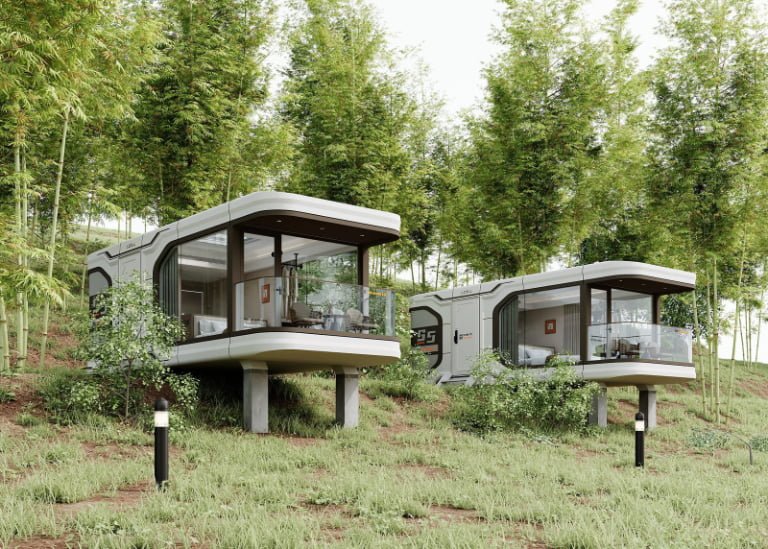
It is simple. The capsule is tangible. You can see renders. You can visit a showroom. You can compare interior materials — carbon crystal panels, stone plastic flooring, privacy glass doors. [3][5] It feels like progress. But it is not.
The real project risk lives in five areas that happen outside the factory:
| Risk Area | What Goes Wrong | When It Shows Up |
|---|---|---|
| Transport & last-mile logistics | No dock, no crane, no road to site | After capsules arrive at port |
| Local permits & compliance | Building codes, environmental review, land use | Before or during site preparation |
| Site preparation & foundations | Wrong soil, no surveying, no local contractor | Weeks before capsule delivery |
| Off-grid infrastructure | No power system, no water, no wastewater plan | At installation and commissioning |
| Operations readiness | No maintenance plan, no spare parts, no trained staff | After soft opening |
I tell every client the same thing: do not start choosing capsule colors until you have answered these five questions. The capsule will be fine. Your site might not be.
What Transport and Last‑Mile Problems Kill Island Projects?
You found a beautiful remote island. But "remote" also means "hard to reach." Most developers underestimate what it takes to physically move a finished capsule from a Chinese port to an island site.
Transport failure is the number one reason capsules sit in ports for weeks or months. Developers do not plan for vessel size limits, dock capacity, crane availability, or customs clearance at the destination. A capsule that cannot reach your site is just expensive storage.
What are the specific last-mile problems developers miss?
Let me list the ones I have seen personally.
Port to island transfer. Your capsule arrives at a mainland port in a standard shipping container. But how does it get to your island? You need a barge or cargo vessel small enough to reach your island but strong enough to carry a 6–10 ton capsule. Not every island has a dock that can handle this. Some islands require beach landings, which means a flat-bottom barge and calm seas.
Crane access. Once the capsule reaches the island, you need a crane to lift it off the barge and onto your prepared foundation. A 25-ton crane is the minimum. If your island has no road access, you may need a barge-mounted crane — which costs significantly more and must be booked weeks in advance.
Customs and import regulations. Every country treats modular buildings differently at customs. Some classify them as "prefabricated structures." Some classify them as "containers." Some classify them as "temporary buildings." The classification affects your import duty, your required documentation, and sometimes your ability to import at all.
| Last-Mile Challenge | What You Need to Plan | Lead Time |
|---|---|---|
| Barge or vessel charter | Identify local maritime transport provider | 4–8 weeks before arrival |
| Dock or beach landing assessment | Survey the landing zone, check tidal conditions | Before ordering |
| Crane rental (land or barge-mounted) | Book crane, confirm capacity and reach | 4–6 weeks before arrival |
| Customs classification | Confirm HS code, prepare import documents | Before shipping |
| Local road or path to site | Check if capsule dimensions fit existing paths | Before ordering |
The lesson is clear: plan your transport chain backward from the final placement point, not forward from the factory gate.
Why Do Permits and Environmental Approvals Stall Projects for Months?
You found the perfect island. You have the budget. But the local government says no — or says nothing at all for six months.
Permitting is the most unpredictable risk in off-grid resort projects. Environmental reviews, land use approvals, building code compliance, and coastal zone regulations can each add months to your timeline. And no capsule manufacturer or trade partner can control this process for you.
What types of permits do island resort developers actually need?
This varies by country and jurisdiction. But in my experience, there are four categories that show up in almost every island project:
1. Land use or lease approval. Do you have the legal right to build on this land? Is it zoned for commercial hospitality use? On many islands, land ownership is complicated — communal land, government land, or overlapping claims.
2. Building permits. Even for modular, prefabricated structures, most jurisdictions require some form of building permit. You need structural calculations, fire safety compliance, and sometimes seismic ratings. This is where technical datasheets from the manufacturer become critical — your local architect or engineer needs them to submit the permit application.
3. Environmental impact assessment. Islands in coastal or marine protected areas often require a formal EIA. This evaluates your project's impact on marine life, vegetation, freshwater sources, and waste output. Modular and relocatable structures have an advantage here because they cause less permanent ground disturbance, but you still need to go through the process.
4. Utility and discharge permits. If you are operating a desalination system, you need approval to intake seawater and discharge brine. If you have a wastewater treatment system, you need approval for treated water discharge standards.
| Permit Type | Typical Timeline | Who Handles It |
|---|---|---|
| Land use / lease | 2–12 months | Client's legal team |
| Building permit | 1–6 months | Client's local architect/engineer |
| Environmental impact assessment | 3–12 months | Client's environmental consultant |
| Utility discharge permit | 1–3 months | Client's local team |
My role is to provide the technical documents your local team needs — structural specs, material certifications, system capacity data. But the permit process itself is 100% a local responsibility. I always tell clients: start permits first, order capsules second.
What Happens When Off‑Grid Infrastructure Is an Afterthought?
The capsule is a guest room. But a guest room without power, freshwater, hot water, and working toilets is not a resort. It is a very expensive shipping container on a beach.
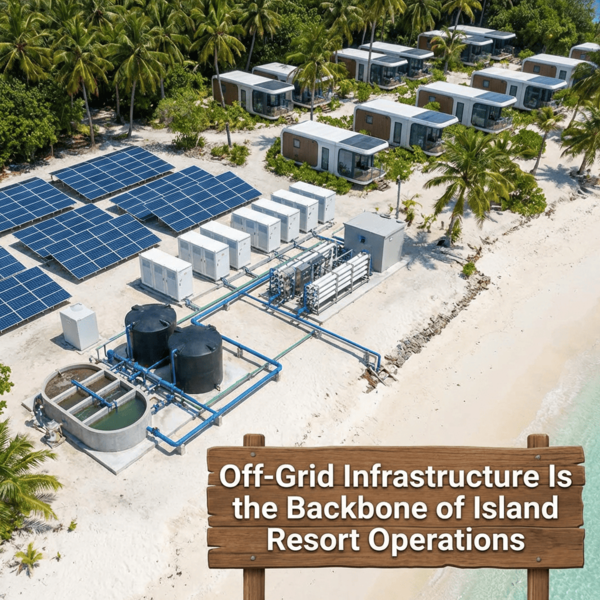
Off-grid infrastructure — solar power, energy storage, seawater desalination, water purification, and wastewater treatment — is not an add-on. It is the backbone of your entire resort operation. Developers who treat it as a Phase 2 item end up with capsules they cannot use.
What systems do you actually need — and why must they be planned from Day 1?
I coordinate these systems as containerized, modular units that ship alongside your capsules. But the sizing, layout, and connection points must be designed at the very beginning of the project — not after the capsules are already on order.
Here is why: your solar array size depends on how many capsules you have, what appliances are inside, and whether you need air conditioning. Your desalination system capacity depends on your guest count plus staff plus irrigation. Your wastewater system capacity depends on your total water throughput. Everything is connected.
| System | What It Does | Sizing Depends On |
|---|---|---|
| Solar + battery storage | Primary power supply | Number of units, AC load, kitchen equipment |
| Diesel backup generator | Emergency and peak power | Total peak demand |
| Seawater desalination (SWRO) | Produces freshwater from seawater | Guest count + staff + cleaning + irrigation |
| Water purification (RO) | Produces drinking-quality water | Guest count + F&B operations |
| Wastewater treatment (A2/O) | Treats all greywater and blackwater | Total water throughput |
| Food waste processing | Handles kitchen and organic waste | F&B operation scale |
If you order 15 capsules but only plan power for 10, you have a problem on Day 1 of operations. If your desalination system produces 5 tons per day but your resort needs 8, your guests will run out of water. These are not hypothetical scenarios. I have seen them happen.
The fix is simple: plan infrastructure at the same time as capsule selection. I provide system sizing recommendations as part of the Concept Design phase, and I source the containerized systems from the same supply chain window as the capsules. Everything ships together. Everything arrives together. Everything gets commissioned together.
Why Does "Operations Readiness" Catch Developers Off Guard?
The capsules are placed. The solar panels work. The water is flowing. But there is no maintenance manual in a language your staff reads. No spare parts on the island. No protocol for when the inverter shuts down at 2 AM.
Operations readiness is the final — and most overlooked — failure point in off-grid resort projects. A resort that cannot maintain itself after opening will degrade fast, generate bad reviews, and lose money within months.
What does "operations ready" actually mean for an off-grid island resort?
It means your team can run the resort without calling China every time something breaks. That sounds obvious. But most developers do not plan for this until after they open.
Here is what I include in the After-Sales and handover phase:
Technical documentation. Every capsule and every containerized system ships with spec sheets, wiring diagrams, and maintenance schedules. I make sure these are available in English and, where possible, translated for the local operations team.
Spare parts inventory. I help clients build a starter inventory of common replacement items — filters for the desalination system, fuses, pump seals, door hardware, smart control boards. These are inexpensive but critical. If a water pump fails and the nearest replacement is 4 weeks away by sea, your resort is closed.
Staff training guidance. I provide basic operation guides for the off-grid systems. Your local team should know how to monitor the solar battery charge, backwash the desalination filters, and restart the wastewater system after a power interruption.
Remote support. I stay available after handover for technical troubleshooting, spare parts sourcing, and future expansion planning.
| Operations Readiness Item | Why It Matters | When to Plan It |
|---|---|---|
| Maintenance manuals in local language | Staff can troubleshoot without external help | During production phase |
| Spare parts starter kit | Avoid weeks of downtime waiting for parts | Ship with capsule order |
| Staff training on off-grid systems | Prevent operator errors that damage equipment | During commissioning |
| Remote support channel | Quick access to technical advice | Set up before soft opening |
| Expansion and reconfiguration plan | Know how to add units in Phase 2 | During Concept Design |
The goal is simple: when I step back after commissioning, your resort should be able to operate independently. If it cannot, the project is not finished — no matter how beautiful the capsules look.
Conclusion
Off-grid resort projects fail not because the capsule cannot be built, but because transport, permits, infrastructure, and operations were treated as afterthoughts — plan all five together from Day 1, and you will actually open on time.