
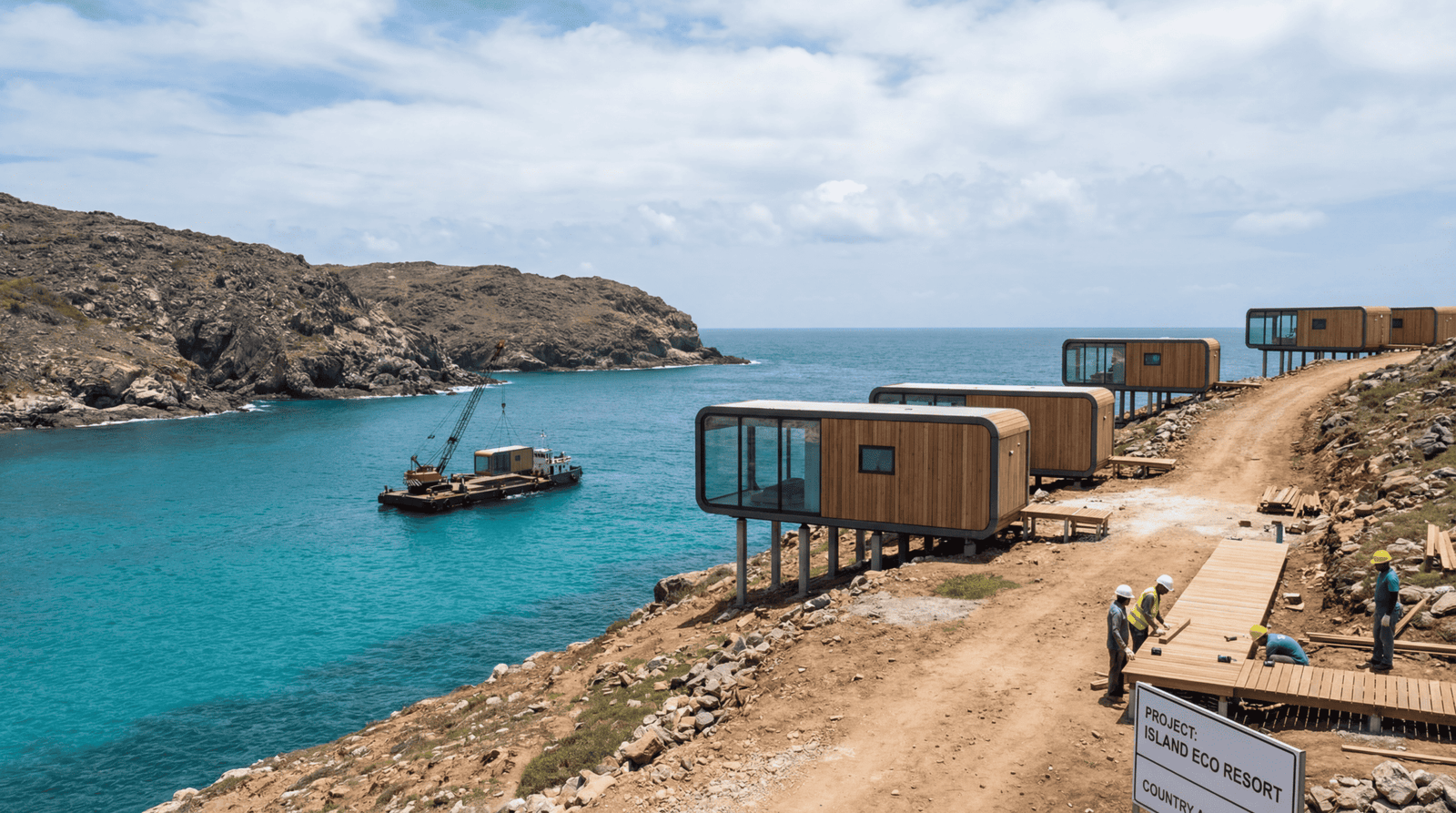
Project: Island Eco Resort, Country A
A modular capsule resort delivering sea‑view accommodation on a remote island, with reduced on‑site construction, clearer risks, and a faster path to opening.
This case study outlines how an island eco resort in used modular capsule units and a coordinated off‑grid approach to transform a challenging, infrastructure‑poor site into a functioning resort within a predictable timeframe. The focus is not only on the capsule products themselves, but on logistics, foundations, utilities, and clear responsibility sharing between all parties.
Project Overview
Location
(accessible by boat only)
Project Type
with sea‑view guest units and minimal environmental impact
Client
Local resort developer targeting international eco‑tourists and couples
Site Conditions
- No existing grid power
- Limited fresh water
- Simple jetty and unpaved internal tracks
- Strong coastal winds and salt exposure
Objectives
- Add 12-15 guest units plus staff and service spaces
- Minimize heavy construction and concrete use
- Achieve opening within one peak season window
The developer wanted to avoid a multi‑year traditional build with heavy structures and instead aimed for a modular, low‑impact solution that could be implemented within one construction season, while keeping future expansion options open.
Key Challenges Before Choosing Modular Capsules
The client initially considered conventional villas and cabins, but several critical constraints appeared during early feasibility discussions:
Logistics and Access
Transporting large volumes of building materials and equipment by small cargo boats and limited‑capacity cranes would have required many trips and long on‑site work.
Limited Construction Window
The island has a short dry season overlapping with peak tourist low season, providing only a few months per year for heavy works, with strong winds and storms outside that window.
Infrastructure Gaps
No reliable grid electricity, limited fresh water sources, and no existing wastewater treatment made traditional hotel systems impractical without major investment.
Environmental and Regulatory Scrutiny
Authorities required the resort to minimize ground disturbance, visual impact, and wastewater discharge, and to demonstrate how structures could be removed or relocated if needed.
This combination made a conventional build slow, risky, and difficult to justify to investors.
Modular Capsule Solution for the Island Site
To address these constraints, the client decided to adopt a capsule‑based approach, combining prefabricated units with light foundations and integrated utility interfaces.
Capsule Mix and Functions
Guest Units
- 6 × S5 Capsules - standard sea‑view guest rooms for couples
- 4 × S6 Capsules - larger units for small families or longer stays
- 2 × S7 Capsules - premium front‑row units for honeymoon and special occasions
Staff and Support Units
- 3 × S2 Capsules - staff accommodation and on‑site management
- 1 × S2 Capsule - housekeeping and storage
- 1 × Service / Utility Capsule - small office, laundry, and technical room
Off‑Grid Utility Concept
- Hybrid power strategy combining solar + battery with generator back‑up
- Compact water production and treatment system sized to guest capacity
- Pre‑defined electrical and plumbing interface points on each capsule
- Light foundations designed to be reversible and minimize ground disturbance
The result was a modular resort "kit" that could be shipped, installed, and expanded in phases.
Site Layout and Guest Experience Design
The masterplan aimed to balance views, privacy, and operational efficiency. Capsules were grouped to follow the island's natural contours and prevailing wind direction, while reserving service routes for staff.
Guest Capsule Placement
- S5 and S6 capsules positioned along the main sea‑view ridge, each with its own deck and view corridor.
- S7 premium capsules located at the most iconic viewpoints, with increased spacing for privacy and noise separation.
- Orientation optimized to capture sunrise or sunset views while reducing direct wind exposure.
Back‑of‑House Integration
- Staff housing capsules placed within walking distance of the main resort core, but outside primary guest sightlines.
- Utility and storage capsules located near the jetty and service paths, simplifying deliveries and waste removal.
- Service routes planned to minimize crossing guest pathways, reducing operational friction.
This layout allowed the resort to create differentiated room categories and pricing levels while maintaining a coherent operational flow.
From Concept to Soft Opening: Timeline
One of the client's main goals was to open within the next peak season. The use of modular capsules enabled off‑site production to run in parallel with on‑site preparations.
Discovery and Feasibility
- Review of island maps, photos, climate, and regulatory context
- Preliminary capacity planning (number and type of units)
- Rough budget range and timeline scenario shared with the client
Concept and Technical Specification
- Selection of capsule models (S2/S5/S6/S7) and interior packages
- Basic site layout proposal and capacity mix
- Technical datasheets and interface points provided for local engineer review
Factory Production and Site Preparation (in parallel)
- Capsules manufactured, assembled, and inspected at the factory
- On the island, local contractor constructs light foundations, access paths, and utility trenches
- Adjustments made based on actual site measurements and engineer feedback
Shipping and On‑Island Handling
- Capsules shipped by sea, transferred to smaller craft where necessary
- Local cranes and lifting equipment arranged with load and radius constraints confirmed in advance
Installation and Commissioning
- Capsules placed on prepared foundations, leveled, and anchored
- Electrical and plumbing connections made according to interface drawings
- Systems tested using checklists, followed by soft opening and staff training
This parallel workflow significantly reduced total on‑site construction time compared with traditional methods.
Clear Roles Between Client, Local Partners, and Capsule Housing
To keep the project manageable and transparent, responsibilities were clearly divided from the start. This reduced misunderstandings and helped each party focus on what they do best.
Capsule Housing
- Advising on feasibility, capsule mix, and layout concepts
- Coordinating with capsule manufacturers and system suppliers
- Providing technical datasheets, interface drawings, and installation guidelines
- Assisting with shipping arrangements and documentation
- Offering remote technical support during installation and commissioning
Client and Local Partners
- Securing land rights, permits, and environmental approvals
- Engaging local architect/engineer for foundation and code compliance
- Constructing foundations, jetty improvements, and internal paths
- Handling customs clearance, local taxes, and on‑island transport
- Hiring and managing local installation and operations staff
This shared responsibility model ensured that essential local decisions remained in local hands, while technical and supply‑chain complexity was coordinated centrally.
Technical Design and Environmental Considerations
Structural and Material Choices
- Steel frame capsules with insulated wall and roof panels designed for coastal wind loads and salt exposure.
- Exterior finishes selected with corrosion resistance in mind, reducing premature wear.
- Light foundations (pads or strip footings) allowed installation without extensive excavation.
Resource Efficiency and Impact
- Majority of construction work completed off‑site, reducing noise, dust, and waste on the island.
- Utility systems sized to match realistic occupancy scenarios, reducing over‑investment and wasted capacity.
- Capsule layouts and positioning designed to preserve existing vegetation where possible and keep built footprint compact.
By combining modular construction with considered material choices, the resort improved long‑term resilience and reduced environmental impact.
Outcomes and Lessons Learned
Time to Operation
Project moved from initial concept to soft opening in approximately six months, aligning with the targeted season window.
Construction Impact
On‑site heavy construction activity was concentrated into a shorter period, reducing disruption to neighboring areas and the island environment.
Operational Flexibility
The resort opened with a core set of 12 guest capsules and has clear options to add more units in later seasons.
Guest Response
Early guests responded positively to the combination of private sea‑view units, comfort, and perceived sustainability, supporting premium room rates.
Lessons Learned
Logistics planning is a design task, not an afterthought.
Confirming crane capacities, jetty conditions, turning radii, and storage areas early prevented costly surprises during installation.
Local engineering input is essential.
Capsule datasheets and loads were necessary but not sufficient; the local structural engineer's design of foundations and anchoring was critical for safety and compliance.
Clear expectations reduce friction.
By defining what was and was not included in the capsule scope, both sides avoided many common disputes around "who should have done what".
These lessons now inform how Capsule Housing approaches other island and remote projects.
Plan Your Own Island Capsule Resort
If you are considering an island or coastal project with similar constraints--limited infrastructure, tight construction windows, and high environmental expectations--we can help you assess whether a capsule‑based approach is appropriate. Based on your site, business model, and timeline, we can prepare an initial capsule mix, layout idea, and budget range for internal discussions.
Get an island resort capsule concept for my site