You found the perfect island. But there is no power grid, no freshwater, and no paved roads. Traditional construction here could take years. It does not have to.
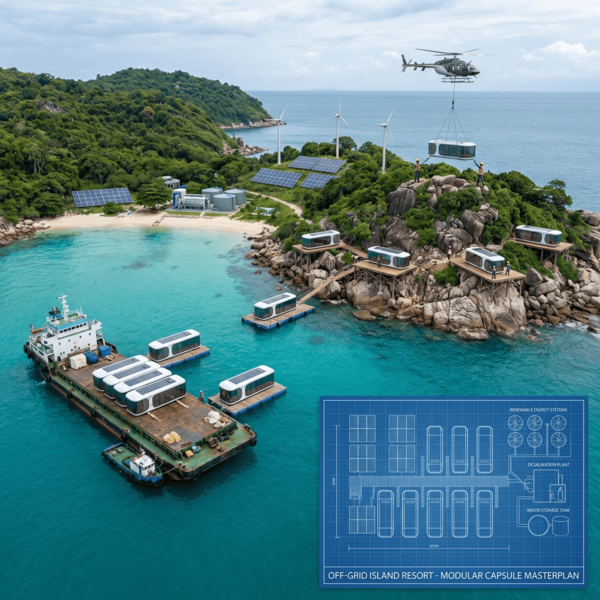
Planning an off-grid island resort starts with solving three problems at once: transport logistics, self-sufficient infrastructure, and environmental compliance. Modular capsule housing lets you prefabricate guest units and utility systems in a factory, ship them by sea, and deploy on site in 10–16 weeks — without building a traditional construction site on a fragile island ecosystem.
I have been in international trade for over 20 years. My work now focuses on helping resort developers connect with proven Chinese capsule manufacturers and off-grid system suppliers. I coordinate the technical details so your local architects, engineers, and contractors have what they need. I do not build. I do not design. I fill the gap between your vision and the supply chain. In this guide, I will walk you through the real challenges of island development, show you why modular capsule housing fits this scenario so well, give you a 10–16 week timeline, and share two configuration examples you can use as starting points.
What Makes Island Resort Development So Difficult?
Islands look beautiful in photos. But for developers, they come with a unique set of problems that most mainland contractors are not prepared for.
The three biggest challenges for off-grid island projects are transport access, lack of basic infrastructure (power, water, wastewater), and strict environmental review processes. Each one can delay a traditional build by months or even years.
How do transport, infrastructure, and permits slow down island projects?
Let me break this down. I have seen developers lose entire seasons because they did not plan for these realities.
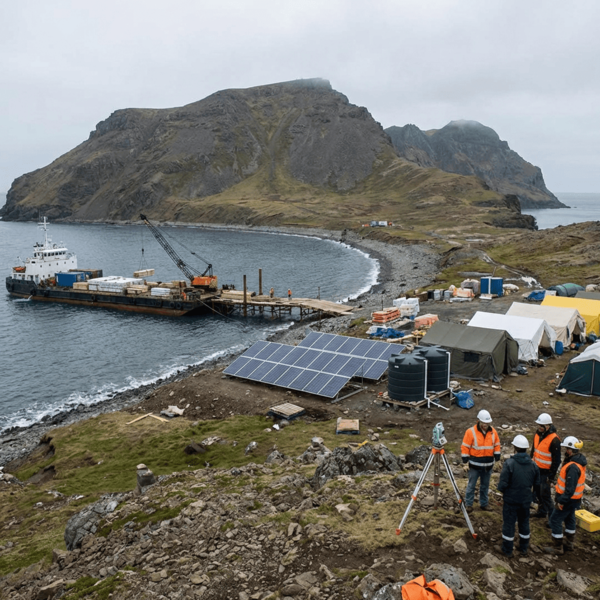
Transport Access Everything — every bag of cement, every steel beam, every toilet — has to arrive by boat. There is no highway. There is often no dock large enough for heavy equipment. Bad weather can shut down deliveries for weeks. This alone makes traditional construction on islands 2–3 times slower than on the mainland.
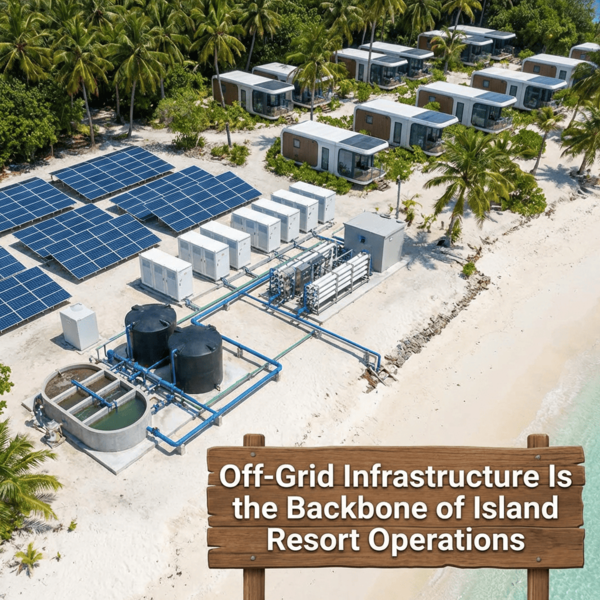
Infrastructure From Zero On most undeveloped islands, you have no grid power, no municipal water, and no sewage system. You must build all of this yourself. That means solar panels, battery storage, diesel backup generators, seawater desalination, water purification, and wastewater treatment. These are not small add-ons. They are entire engineering projects on their own.
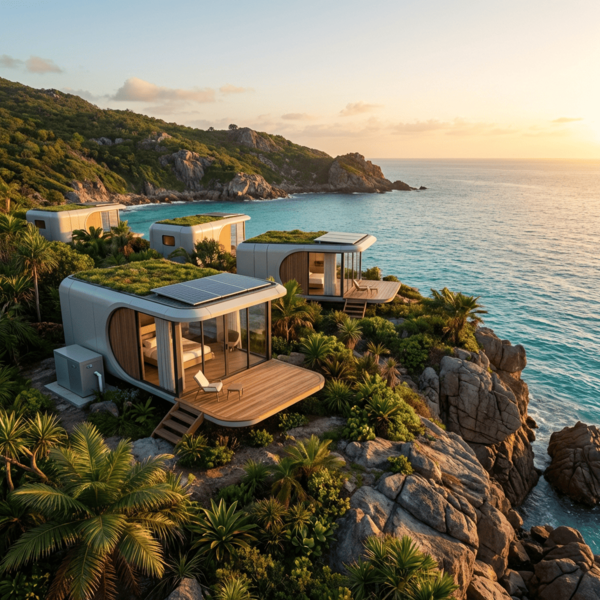
Environmental Approvals Islands are often in protected coastal or marine zones. Governments want to see minimal ground disturbance, low waste output, and reversible construction methods. Traditional concrete and steel buildings are hard to approve in these zones because they permanently alter the land.
| Challenge | Impact on Traditional Build | Impact on Modular Approach |
|---|---|---|
| Transport access | Hundreds of material shipments over months | A few container shipments with finished units |
| No grid power | Must build power plant first | Solar + storage ships in containers, plug-and-play |
| No freshwater | Must drill wells or build desalination plant | SWRO desalination system ships in standard container |
| No sewage system | Must design and build wastewater treatment | A2/O wastewater module ships ready to connect |
| Environmental review | Permanent structures face tough scrutiny | Modular, relocatable units are easier to approve |
Understanding these challenges is the first step. The second step is choosing a building method that works with these constraints instead of fighting against them.
Why Does Modular Capsule Housing Work So Well on Islands?
Conventional wisdom says island construction is slow and expensive. Modular capsule housing breaks that pattern by moving most of the work off the island.
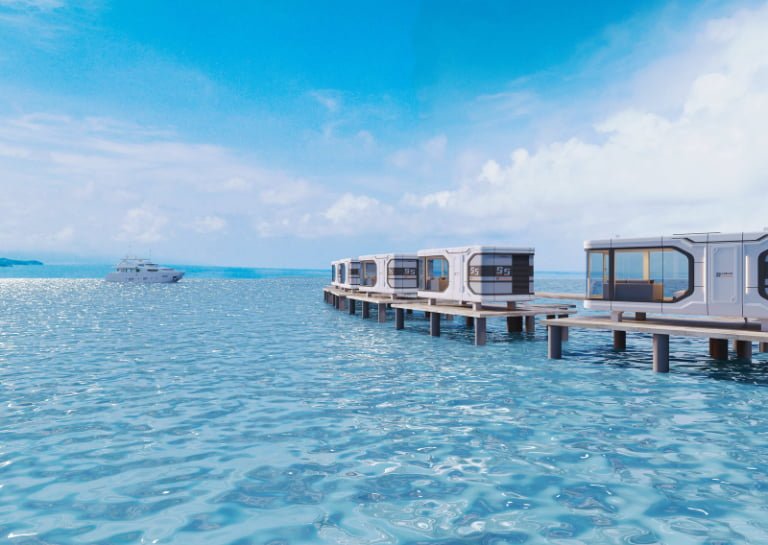
Modular capsules are fully prefabricated in a factory, including interior fit-out, electrical, and plumbing. They ship as finished units by sea and need only light foundations on site — which means less ground disturbance, less on-island labor, and a much shorter construction window.
What specific advantages does the modular approach give island developers?
There are two big advantages that matter most on islands: light foundations and parallel workflow.
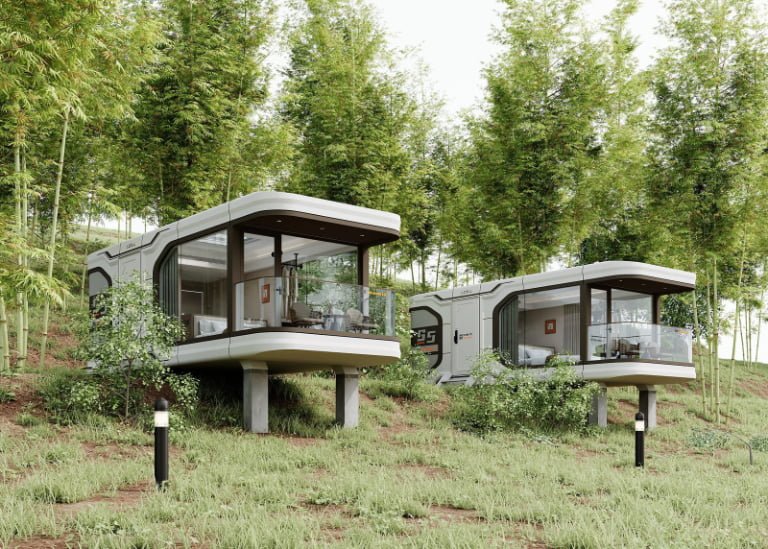
Light Foundations Traditional resort buildings need deep concrete foundations. On islands, the soil is often sandy or coral-based, which makes heavy foundations expensive and environmentally destructive. Capsule units are designed to sit on simple steel piles or concrete pads. The structural load is much lower. This means less excavation, less heavy equipment, and a much smaller footprint on the island's natural landscape.
Parallel Workflow This is where the real time savings come from. While the factory in China builds your capsules and off-grid system containers, your local team on the island prepares foundations and utility trenches. These two work streams happen at the same time. With traditional construction, you cannot start interiors until the structure is done. With modular, the interiors are already finished when the capsule arrives.
| Advantage | How It Helps on Islands |
|---|---|
| Factory prefabrication | No need for large on-island construction crew |
| Light foundations | Less excavation, less environmental impact |
| Parallel workflow | Site prep and production happen simultaneously |
| Containerized shipping | Units designed for sea transport, fit standard cargo routes |
| Relocatable structures | Can be moved if regulations or business plans change |
| Integrated off-grid systems | Solar, desalination, wastewater ship as plug-and-play containers |
I also want to mention one more thing: all supporting systems — power, desalination, water purification, wastewater, even food waste processing — can be integrated into standard shipping containers. This means your entire resort infrastructure ships the same way as your guest capsules. No custom-built power plants. No massive civil engineering projects on a fragile island.
What Does a Realistic 10–16 Week Timeline Look Like?
Developers always ask me: "How fast can we really go?" The honest answer is 10–16 weeks from confirmed order to first guest check-in — if your site is ready and permits are in hand.
A typical island resort project follows six phases: Discovery, Concept Design, Production, Shipping, On-Site Installation, and Commissioning. The total calendar time is 10–16 weeks because factory production and site preparation run in parallel.
How does each phase fit into the 10–16 week window?
Let me show you a week-by-week breakdown. Keep in mind: permitting time is not included here because it varies hugely by country and island jurisdiction. I always tell clients to start the permit process as early as possible — ideally months before they contact me.
| Phase | Timeline | Key Activities | Who Is Responsible |
|---|---|---|---|
| Discovery | Week 1–2 | Site assessment, budget range, capsule model selection | Capsule Housing + Client |
| Concept Design | Week 2–4 | Layout planning, off-grid system sizing, technical datasheets for local engineers | Capsule Housing + Client's local team |
| Factory Production | Week 4–8 | Capsule manufacturing + interior fit-out + off-grid container systems | Manufacturer (coordinated by Capsule Housing) |
| Site Preparation (parallel) | Week 4–8 | Foundation work, utility trenches, dock or landing zone prep | Client's local contractor |
| Shipping | Week 8–12 | Sea freight from China to island port or nearest mainland port | Freight partner + Capsule Housing |
| Installation & Commissioning | Week 12–16 | Crane placement, utility hookup, system testing, soft opening prep | Client's local team + technical guidance |
A few important notes from my experience:
Shipping time depends on distance. Southeast Asian islands might be 2 weeks from a Chinese port. Caribbean islands might be 4–5 weeks. Always add buffer for customs clearance at the destination.
The factory production phase for capsules is roughly 30 days. Off-grid system containers are produced in a similar timeframe. Because both happen at the same time as your site preparation, you do not lose time waiting.
The installation phase on island sites is usually 1–2 weeks for placing and connecting units. But this assumes you have crane access. If your island has no dock for heavy equipment, you may need a barge-mounted crane, which adds cost and scheduling complexity.
What Do Real Island Resort Configurations Look Like?
Theory is useful. But developers want to see specific layouts and numbers. Here are two configuration examples I use as starting points for client conversations.
A small island resort (10–15 capsule units) and a medium island resort (20–30 capsule units) represent the most common project scales I work with. Each has different infrastructure needs, cost ranges, and operational profiles.
What does a 10–15 unit island resort include — and what about a 20–30 unit project?
Configuration A: Boutique Island Resort (10–15 Units)
This is the entry point for most developers. It works well for a small private island or a section of a larger island. The target market is high-end couples and small groups looking for a remote, exclusive experience.
| Component | Quantity / Spec | Notes |
|---|---|---|
| Guest capsules (28–38 m²) | 10–15 units | Mix of standard and premium with balcony |
| Staff / utility capsule | 1–2 units | Housekeeping, storage, basic office |
| Solar + storage container | 1 unit | 30–50 kW solar + lithium battery storage |
| Seawater desalination container | 1 unit | SWRO system, 5–10 tons/day capacity |
| Wastewater treatment container | 1 unit | A2/O process for biological treatment |
| Water purification container | 1 unit | Reverse osmosis for drinking water |
| Estimated total cost range | $300K–$600K | Capsules + off-grid systems + shipping (excludes local site work) |
| Timeline | 10–14 weeks | From order confirmation to commissioning |
This scale is manageable. You need a small local crew for foundations. One or two crane days for placement. And the off-grid systems can support this number of units comfortably.
Configuration B: Medium Island Resort (20–30 Units)
This is for developers who want a full resort operation — with reception, restaurant, and possibly a spa or activity center. The island needs more space, and you need a more robust infrastructure backbone.
| Component | Quantity / Spec | Notes |
|---|---|---|
| Guest capsules (18–38 m²) | 20–30 units | Mix of room types for different guest segments |
| Staff / back-of-house capsules | 3–5 units | Staff quarters, laundry, maintenance, storage |
| Common area / reception | 1–2 larger modular units | Can be custom-configured containers |
| Solar + storage containers | 2–3 units | 80–150 kW solar array + expanded battery bank |
| Seawater desalination container | 1–2 units | 15–30 tons/day capacity |
| Wastewater treatment containers | 1–2 units | Scaled A2/O system |
| Food waste processing container | 1 unit | Anaerobic digestion for kitchen waste |
| Satellite communication | 1 system | Starlink or similar for guest Wi-Fi |
| Estimated total cost range | $700K–$1.5M | Capsules + all systems + shipping (excludes local site work) |
| Timeline | 12–16 weeks | From order confirmation to commissioning |
At this scale, I always recommend phased deployment. Start with 10–15 units in Phase 1. Open for guests. Use the revenue to fund Phase 2 expansion. This reduces your upfront financial risk and lets you test the market before committing to full scale.
One more thing: these cost ranges are for the capsules, off-grid systems, and international shipping. They do not include your local costs — land lease, permits, foundations, crane rental, local labor, landscaping, furniture beyond what comes in the capsule, and marketing. I am always transparent about this. Anyone who gives you a single "all-in" price for an island resort project is leaving something out.
Conclusion
Off-grid island resort development is hard — but modular capsule housing with integrated off-grid systems turns a multi-year construction project into a 10–16 week deployment, so you can welcome guests sooner and with less risk.