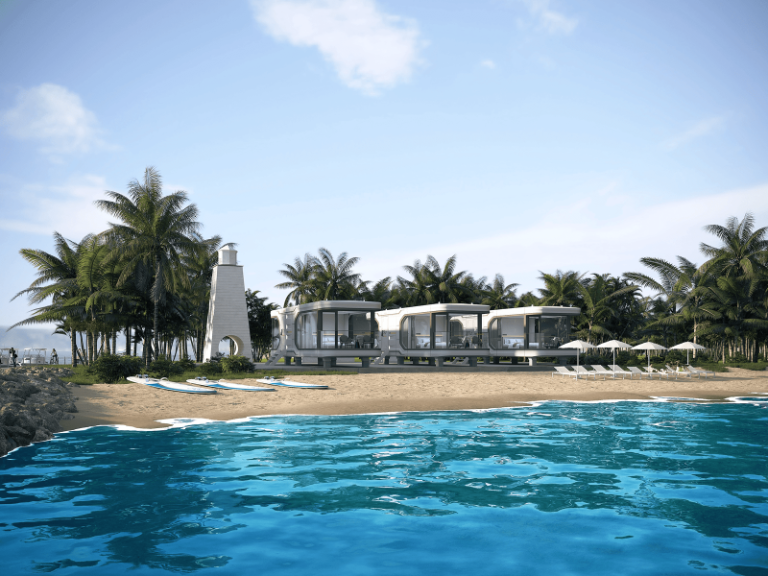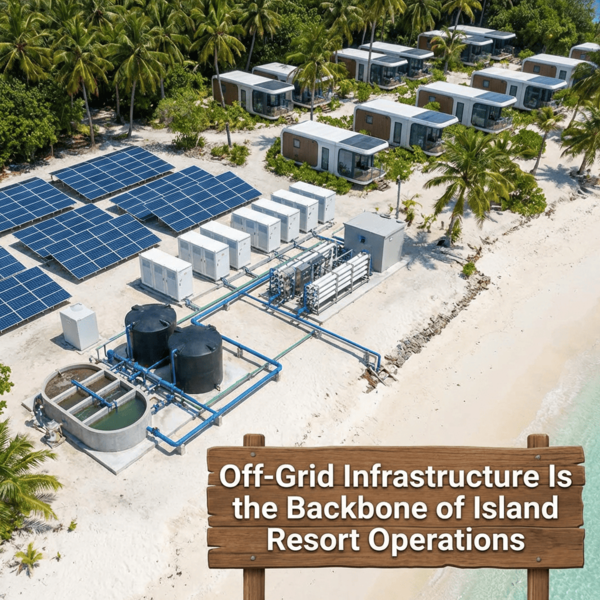
Every developer I talk to for the first time asks the same question: "How much does one capsule cost?" It is a fair question. But it is the wrong starting point — because price alone has never saved a failed project.
When clients first inquire about capsule projects, they focus on unit price. But by the time they are ready to commit, the question has always shifted to "How controllable is this entire project?" Price is the entry point. Controllability is what closes the deal.
I have been in international trade for over 20 years. I started with valves and sanitary hardware, and now I coordinate off-grid capsule resort projects for island and remote-site developers. In every product category I have ever worked in, the pattern is the same. The first conversation is about price. The final decision is about risk. The developers who succeed are the ones who make that shift early. The ones who fail are still comparing unit prices when their capsules are stuck in customs, their foundations are wrong, and their off-grid systems do not match their capsule interfaces. In this article, I will explain why price is only the surface, what "controllability" actually means in a capsule resort project, and how to evaluate a partner based on risk reduction instead of discount depth.
Why Is "How Much per Unit?" the Wrong First Question?
I do not blame anyone for asking about price first. It is natural. But in off-grid capsule resort projects, the unit price tells you almost nothing about your actual project cost or risk.
Unit price is misleading because it covers only one part of a much larger project. A capsule unit might cost $25,000–$50,000 depending on size and configuration.But the total cost to get that capsule operational on your island includes shipping, customs, transport, foundations, crane placement, off-grid systems, permits, local labor, and commissioning — often doubling or tripling the capsule price.
What does the unit price actually include — and what does it leave out?
Let me show you the gap between what most developers think they are buying and what they actually need.
A capsule unit from a proven Chinese manufacturer typically includes the steel structure, insulation, interior decoration (carbon crystal board ceilings and walls, stone plastic flooring), bathroom fit-out (privacy glass door, glass shower partition, toilet, washbasin, faucets, bathtub in some models), lighting system, water and electricity system, card key power system, and switch panels.Some premium models add intelligent voice control, electric curtains, skylight systems, and electric projection screens. [3] This is a complete, furnished guest room. It ships in a standard 40HC container.
But here is what the unit price does not include:
| Included in Unit Price | NOT Included in Unit Price |
|---|---|
| Steel frame structure | International sea freight |
| Polyurethane insulation | Customs clearance and import duties |
| Double glazing glass doors/windows | Port handling and storage fees |
| Full interior decoration | Inland and sea transport to island |
| Bathroom complete fit-out | Crane rental for placement |
| Lighting and electrical system | Foundation design and construction |
| Smart control system (some models) | Off-grid power, water, wastewater systems |
| Mosquito nets | Local permits and professional fees |
| Local labor for installation and connection | |
| Landscaping and guest experience elements |
When a developer compares two suppliers purely on unit price — say, $28,000 vs. $32,000 — they think they are saving $4,000 per capsule. But if the cheaper supplier provides incomplete technical documentation, uses non-standard electrical interfaces, or ships without proper export paperwork, that $4,000 "saving" can turn into $15,000+ in delays, rework, and port storage fees. I have seen this happen more than once.
Price comparison only works when everything else is equal. In cross-border off-grid capsule projects, everything else is almost never equal.
What Does "Controllability" Actually Mean in a Capsule Resort Project?
Developers hear me say "controllability" and they nod. But when I ask them what it means, most cannot define it. So let me be specific.
Controllability means knowing what will happen, when it will happen, who is responsible for each part, and what to do when something goes wrong. In a capsule resort project, controllability covers five dimensions: technical specs, timeline, logistics, responsibility boundaries, and failure response.
How do you measure controllability across the five dimensions?
I use a simple framework when I evaluate projects with clients. For each dimension, I ask: "Do we have a clear, documented answer — or are we guessing?"
1. Technical Spec Controllability. Can your local architect and engineer review the structural calculations, material certifications, fire ratings, and electrical diagrams? Do the capsule interfaces match your off-grid system connections? Are the specs documented in a format your local permit authority will accept?
I provide structural, material, and system datasheets for every capsule model I coordinate. Your local team should be able to open these files and verify compliance with their building codes without calling me.
2. Timeline Controllability. Do you know how long factory production takes? Do you know the shipping transit time? Do you know your customs clearance estimate? Do you know your on-site installation duration? Are these running in parallel where possible?
A typical capsule production cycle is about 30 days. But if you do not know that your destination port takes 3 weeks for customs on prefabricated buildings, your timeline is not controlled — it is hoped for.
3. Logistics Controllability. Do you have a confirmed freight route from factory to island? Do you have a port that can handle your capsule dimensions? Do you have a barge or vessel booked for island transfer? Do you have crane access?
4. Responsibility Boundary Controllability. This is the one most developers miss. Who is responsible for what? In my projects, I clearly separate responsibilities between Capsule Housing (product coordination, technical documentation, export logistics), the manufacturer (production quality, factory QC), and the client's local team (permits, foundations, installation, operations). When something goes wrong — and something always goes wrong — everyone knows whose problem it is.
5. Failure Response Controllability. What happens when the shipment is delayed? What happens when customs reclassifies your capsule? What happens when the crane cannot reach your site? Do you have a Plan B for each scenario?
| Controllability Dimension | Controlled (Good) | Uncontrolled (Risky) |
|---|---|---|
| Technical specs | Full datasheets reviewed by local engineer | "The factory said it's fine" |
| Timeline | Week-by-week schedule with parallel workflows | "Should be about 3 months" |
| Logistics | Confirmed freight, port, barge, crane | "We'll figure it out when it arrives" |
| Responsibility boundaries | Written scope for each party | "The supplier handles everything" |
| Failure response | Backup plans documented | "Hopefully nothing goes wrong" |
If you have five "Controlled" answers, your project is in good shape. If you have even two "Uncontrolled" answers, you are gambling — and the stakes are your entire investment plus months of lost revenue.
Why Do Developers Who Buy on Price End Up Paying More?
This sounds like a sales pitch. It is not. It is a pattern I have watched repeat across dozens of projects over 20 years in international trade.
Developers who choose suppliers based on the lowest unit price consistently spend more on total project cost — because they pay for the gaps later, in the form of delays, rework, missing documentation, customs problems, and mismatched systems.
Where do the hidden costs actually show up?
Let me map this out. I am not talking about theory. These are real cost categories I have seen hit real projects.
Incomplete documentation costs. A cheaper supplier may not provide structural test reports, fire safety certificates, or material composition declarations in English. Your local architect cannot submit a permit application without these. Getting them after the fact — translated, certified, and shipped — takes 2–4 weeks and costs $2,000–$5,000. During those weeks, your local crew is idle, your crane booking expires, and your weather window closes.
Interface mismatch costs. The capsule's electrical system uses one voltage or connector standard. Your off-grid solar and battery container uses another. Nobody checked compatibility before shipping. Now you need an electrician to rewire on-site, custom adapters, and possibly a transformer. Cost: $1,000–$3,000 per capsule. Time: 1–2 weeks.
Logistics coordination costs. The cheapest supplier quotes FOB (Free on Board) — meaning their responsibility ends when the capsule is loaded onto the ship in China. Everything after that is yours. If you have never arranged international freight for oversized prefabricated structures, you will learn the hard way that booking a container slot, arranging port handling, and coordinating customs documentation is a specialized skill.
Quality and warranty costs. A capsule that arrives with water damage, scratched interior panels, or a malfunctioning smart control system needs repair. On a remote island, repair means flying in a technician or shipping replacement parts by sea. One damaged bathtub that costs $200 to replace at the factory costs $2,000 to replace on an island.
| Hidden Cost Category | Typical Impact | Could It Have Been Avoided? |
|---|---|---|
| Missing documentation | $2K–$5K + 2–4 weeks delay | Yes — require full document package before payment |
| Interface mismatch | $1K–$3K per unit + 1–2 weeks | Yes — verify off-grid system compatibility during design |
| Uncoordinated logistics | $5K–$20K in port fees and rebooking | Yes — plan full logistics chain before shipping |
| On-site quality repairs | $1K–$5K per issue + weeks of delay | Yes — pre-shipment inspection |
| Permit rejection due to missing certs | Months of delay, possible redesign | Yes — confirm local requirements before ordering |
The pattern is clear. Every dollar "saved" on unit price creates a potential cost multiplier downstream. The developers who understand this shift their evaluation criteria from "who is cheapest" to "who reduces my total project risk."
How Should Developers Evaluate a Capsule Partner Based on Controllability?
If price is not the right filter, what is? I will give you the exact questions I think developers should ask — and the answers that separate a real project partner from a catalog sender.
Evaluate capsule partners on five criteria: documentation completeness, logistics support depth, responsibility clarity, reference project experience, and transparency about limitations. A partner who scores well on these five will cost more per unit but save you far more on total project delivery.
What are the five evaluation questions — and what do good answers sound like?
Question 1: "Can you provide complete technical documentation for my local engineer and permit authority?"
A good answer: "Yes. We provide structural calculations, material certifications, fire safety test reports, electrical diagrams, plumbing schematics, and system datasheets in English. Here is a sample package from a previous project."
A bad answer: "We can send you the brochure."
I provide full technical documentation for every capsule I coordinate.This includes specifications for the main structure (40HC shipping container frame, polyurethane insulation, double glazing glass), interior materials (carbon crystal board, stone plastic floor, artificial stone), and all water, electrical, and smart control systems. Your local team should never have to guess what is inside the capsule.
Question 2: "How do you support logistics from your factory to my island?"
A good answer: "We prepare all export documents, coordinate freight booking, provide container tracking, and support your local broker with customs documentation. We can also advise on port selection, barge requirements, and crane specifications based on your site."
A bad answer: "We ship FOB. After that, it's your responsibility."
Question 3: "How do you define responsibility boundaries between you, the factory, and my local team?"
A good answer: "Here is our standard scope matrix. It shows exactly what we handle, what the manufacturer handles, and what your local team must handle. Permits, foundations, and installation are always local responsibilities. We provide technical guidance but do not replace your local professionals."
A bad answer: "We take care of everything." (Nobody takes care of everything in a cross-border project.)
Question 4: "Can you show me reference projects in similar environments?"
A good answer: "Here are three island or coastal projects where our capsule models have been deployed. Here are photos, specs, and lessons learned."
A bad answer: "We have sold to many countries." (Without specifics, this means nothing.)
Question 5: "What can you NOT do?"
A good answer: "We cannot guarantee your local permit timeline. We cannot control customs clearance speed. We cannot replace your local architect, engineer, or contractor. We provide technical information so they can do their jobs. Here is what we recommend you handle locally."
A bad answer: silence — or a change of subject.
| Evaluation Criteria | Good Partner Signal | Red Flag |
|---|---|---|
| Documentation | Full technical package available now | "We'll send it later" |
| Logistics support | End-to-end coordination with clear handoff points | FOB only, no further support |
| Responsibility clarity | Written scope matrix | "We handle everything" |
| Reference projects | Specific examples with details | Vague claims |
| Transparency about limits | Openly states what they cannot control | Promises everything |
The developer who asks these five questions before comparing prices will make a better decision every time. Because they are not buying a capsule. They are buying a controlled path from concept to first guest check-in.
Conclusion
The first conversation is always about price — but the final decision is always about controllability. Evaluate your capsule partner on documentation, logistics, responsibility clarity, references, and honesty about limitations, and your project will cost less and open sooner than if you chased the lowest unit price.